Choosing the right video monetization platform can be key for your creator business. Just like choosing a co-founder when you launch a new business, the video platform of your choice can make or break your business. You already know that the hardest part of monetizing video isn’t necessarily creating the content, but reaching the right audience and focusing on the right topics.
Some video platforms take a massive cut of your revenue (up to 30-50%). Others hold your audience hostage, meaning you can’t export your email list if you ever decide to leave. And many are just massive libraries where a single algorithm change can wipe out your traffic overnight.
Choosing a platform is really about deciding where you want your business to live. Do you want to build on someone else’s brand for quick reach, or build your own hub for long-term stability?
This guide cuts through the marketing fluff. We’ll look at the actual business models behind these platforms, the hidden “gotchas” that usually only appear after you’ve signed up, and how to build a stack that you won’t have to tear down in six months.
Choosing your monetization method
Before looking at specific tools, you need to know how you plan to make money. The “best” platform for a YouTuber is not always great for a course creator, and vice versa.
- If you need maximum reach above all else: Start with ad revenue models (like YouTube). Just know that you are trading control for discovery.
- For predictable, recurring income: A membership model is the standard. You’ll need a platform that handles gated access and recurring billing seamlessly.
- B2B or niche experts can sell video courses or coaching sessions.
Most popular video monetization models
1) Ad revenue share
With platforms like YouTube, ads are the main monetization method. This is the volume game. You upload content for free, the platform (which already has a large user-base) runs ads over it, and you get a share of the earnings.
The barrier of entry is low – just start uploading videos and that’s it – no costs or other overhead. But here’s the deal, you need massive view numbers to make a living. Revenue swings wildly, you have zero ownership of the viewer, and if the platform decides your content is “not suitable for advertisers,” your income vanishes overnight. Ask any creator who’s been demonetized.
2) Memberships and subscriptions
Recurring revenue is the holy grail for business predictability and stability – it lets you forecast income and invest in better production. It can be hard to bring-in a significant audience, since your content would naturally be mostly premium/paid, but once you do start to stack subscribers, it can become your main revenue source.
It’s important to keep delivering value to the audience when you sell a recurring membership/subscription – they may simply stop paying and churn if you stop releasing new videos.
3) Pay-per-view or one-time purchases
Pay-per-view typically works well for live events like concerts, sports and so on. One-time purchases, on the other hand, can work well with pretty much any content. You can sell online courses in one batch, documentaries, tutorials or any other premium content.
These typically have a higher cost/revenue per transaction compared to ads or memberships, but are one-off purchases – you have to resell your audience every single time.
4) Sponsorships
Video sponsorships also work really well for YouTube creators. Brands and businesses may reach out and ask you to review products, publish tutorials and so on. If you’re using YouTube, you’d possibly double dip here and earn both from ads and sponsorships (assuming you’re getting steady views) so it’s a great combo.
Brand deals can be hard to secure over time, you’d either need a recurring sponsorship from the same brand or try to find a few brands that’d be willing to do sponsor your channel. It might involve quite a bit of sales/outreach to secure deals so always keep that in mind.
5) Hybrid model
This is often the highest-leverage move. Videos are great, but can you add more value to your audience by including more content? Podcasts, blog posts, downloadables, PDFs or other files, planners, templates and so on. Combine your video content with a wider range of products/content and it’d help you take off.
You can charge higher prices for bundles because the perceived value can be much higher than video-only. The limiting factor is usually the platform – you need something that can deliver different file types and manage permissions for all of them in one place. Most video hosts don’t typically deal with this.
How to choose your video monetization platforms
Here are the structural decisions that could actually impact your business.
Who owns the customer?
If a user buys your video, do you get their email address? Can you export that list and move to another platform later? If the answer is no, you are building a house on rented land. When building an audience, ownership is the single biggest factor in long-term value.
The platform “Tax” (fees)
Some platforms take 30% of every dollar you make. That sounds fine when you’re making $100, but it sure hurts when you’re making $10,000 or more.
Rev-share is nice when starting out with $0 upfront cost, but over time it’d become a real pain. Fixed monthly fees (no % based platform fee) are much better as you scale – they are predictable and more sustainable in the long term.
User Experience and Discovery
Two related things to check: the library experience and SEO. If you’re selling a membership, you need to provide a clear way for your members to find and play/consume their content, then also manage their account and so on.
On the SEO side, most video platforms are walled gardens like YouTube or Spotify where your content lives inside their app, with their branding – not on the open web. If you want to rank on Google or LLMs, you need a platform that lets you publish on your own domain with proper schema markup.
Video monetization platforms to consider
Beamly
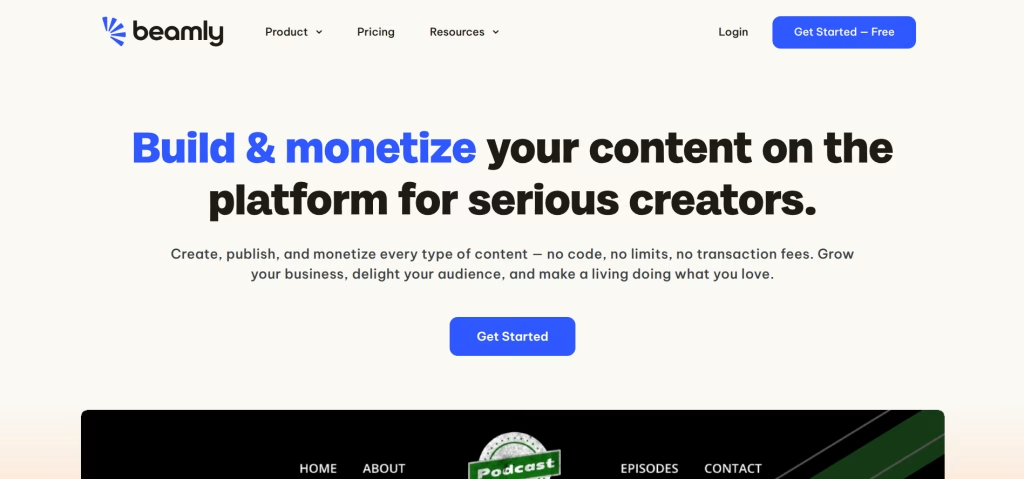
We built Beamly because we saw too many creators stitching together five different tools just to publish and monetize videos. With Beamly you get to keep your audience, members and content on a full website. Beamly provides video hosting, and the ability to sell memberships, downloads, and products all in one place.
It’s perfect for creators who want a central hub they actually own, without the technical headache of WordPress plugins. Beamly charges 0% platform fees on your sales. You keep what you earn. (Stripe fees apply)
YouTube
The undisputed king of video discovery. YouTube is great for top-of-funnel growth and ad revenue, but it may be hard to reach sustainable volume.
It’s also hard to move viewers off-platform, and the “suggested videos” sidebar is designed to distract your audience, not convert them.
Patreon
Patreon is a popular choice for supporting creators via memberships. Patreon is widely known so chances are your audience is familiar with it if not already on there.
The downside, though, is that you’d be building your business on their domain, not yours. Fees are also quite high at about 10% of your revenue.
Uscreen
A popular private streaming platform for video creators. It became popular with fitness instructors or media companies who needed native mobile apps.
It’s a significant monthly investment, usually starting in the hundreds of dollars, but there’s also a per-subscriber fee that may spike the price even further.
Kajabi
Kajabi is an “all-in-one” marketing funnel platform. It’s popular around coaches and course creators who focus on email funnels and automations. It has a very high recurring cost, and some fees are also involved.
Conclusion
The most common mistake we see is creators trying to be everywhere at once. They have a Patreon for members, a Teachable for courses, an online store for merch, and a WordPress for their blog. It’s a nightmare to manage. Beamly is a great solution to consolidate all those tools into one system.
If you want to try a platform that handles the hosting, the website, and the payments without taking a cut of your sales, give Beamly a look. It might just save you from “subscription fatigue” later on.