
When we talk about the creator economy, often the term “content creators” is a bit vague unless you’re already familiar with this industry. In reality there’s many types of content creators and each can be quite versatile.
When everything counts as content, and so many people publishing across every format it’s hard to really find an identity in this space. It’s too easy to publish across formats randomly. One week is YouTube. The next week is TikTok. Then a newsletter or blog. Then a podcast or online course. Long form, short form, repurposed content and more. The result is usually the same – lots of effort, not much momentum, and no clear path to turning content into an audience or income.
That is why it helps to think in types of content creators. Finding your identity is really a strategy decision. It shapes what gets published, where discovery comes from, and which monetization paths make the most sense down the road. Once you establish an identity and long-term strategy, it’d be easier to double down on reach and content monetization.
This guide breaks down the main types of content creators, then gives a practical framework to choose the lane that fits your strengths, schedule, and goals.
What are content creators?
Think of a content creator as someone who publishes content that attracts and keeps attention from a specific audience. Content can really be anything you create, for example:
- video (long-form, short-form, live)
- audio (podcasts, interviews)
- writing (blog posts, newsletters, guides)
- visual (photography, design, illustration)
- community content (posts, discussions, workshops)
- brand work (UGC, ads, sponsored content)
Worth noting: content creators and influencers naturally overlap, but are not necessarily the same thing. Creators tend to be defined by the type and quality of what they produce, while influencers are defined more by the size and responsiveness of the audience following them. Most successful creators become influencers over time, but the foundation is strong, consistent work.
The main types of content creators by format

The most practical way to understand creator types is by format, because format dictates workflow, discovery, and what “growth” actually looks like day to day.
Video creators
Long form video
YouTube is one of the few platforms where a single video can generate views, subscribers, and revenue for years after it was published. A fitness creator who records a detailed body-weight training tutorial today might still be getting daily traffic from that video two years later, because YouTube search and recommendations keep surfacing it.
This compounding reach is why long-form video works so well for creators who teach, review, or explain. Tutorials, comparisons, interviews, walkthroughs, and educational series all fit this lane. Production effort is higher than most other formats though. Planning, filming, editing, generating thumbnails or clips can add up quickly without a good workflow.
Discovery is obvious if you use a platform like YouTube, but you can also use a video hosting service to create your own platform and monetize with subscriptions or one-off payments.
Creators who thrive here tend to think in “libraries” rather than feeds. Each video is an asset that builds on the last.
Short-form creators (TikTok, Reels, Shorts)
Short-form is quite the opposite. While long-form usually rewards depth and patience, short-form is about hooks and speed. You’re fighting against the swipe/scroll clock. A creator can go from zero followers to tens of thousands in a week if a clip catches the algorithm right.
Short-form is ideal for rapid iteration, trend-adjacent storytelling, quick lessons, or behind-the-scenes content. The barrier to entry is the lowest of any video format – a phone and a decent idea are enough to start.
Content usually has a short shelf-life, and monetization is usually indirect unless traffic is funneled somewhere owned – a website, email list, or membership. Many successful short-form creators treat TikTok or Reels as a top-of-funnel channel rather than the money-maker content.
Podcast creators
Podcasting builds a kind of trust that few other formats can match. When someone spends 30 to 60 minutes listening to a host week after week, the relationship feels personal. That depth is why podcast audiences tend to convert well for sponsorships, memberships, and premium content – even when the raw audience numbers look smaller than a viral video channel.
Interview podcasts, solo commentary, narrative series, and educational shows are all proven formats. Discovery can be slower than video, and growth often depends on distribution and consistency rather than a single breakout episode. But creators who are patient with podcasting tend to build remarkably loyal audiences over time.
For a deeper read: How to start a podcast & podcast marketing strategy.
Streaming / Live content
Live streaming is a community-driven format. Where other content types are published and consumed asynchronously, a live stream happens in real time – and that changes the dynamic. Viewers do not just watch, they participate. There’s usually chat, questions, shared reactions and so on and those are all part of the value.
This works well for gaming streams, live coaching sessions, Q&A formats, creative builds (design, coding, art), and live podcasts with audience calls. The recurring schedule builds a habit, and engaged communities can monetize through donations, subscriptions, and memberships.
Where it gets tricky is repurposing as content can rarely be re-used. Time-bound content is hard to turn into evergreen assets unless there is a system for clipping and republishing highlights. Creators who only stream live without pulling clips for YouTube or social often leave growth on the table.
Publishers (writers, bloggers)
Writing is underrated in the creator economy because the results are quiet. There is no viral moment, no subscriber ping, and no algorithm surfacing the work to millions overnight. But a well-written blog post or guide that ranks well on Google or LLMs can drive consistent, high-intent traffic for months or years with minimal maintenance.
How-to guides, tutorials, comparisons, case studies, and thought leadership pieces are the formats that tend to compound. Search and LLM traffic is uniquely valuable because readers arrive with a problem already in mind, which makes written content a strong foundation for selling products, affiliates, and services.
The feedback loop is slower than social. Success requires strong structure, clear outcomes for readers, and patience while search engines index the work.
Newsletter creators (email-first)
Newsletters solve a distribution problem that most other formats struggle with: the audience is owned. When someone subscribes to an email list, that relationship does not depend on an algorithm or a platform policy change.
The conversion path from reader to customer tends to be shorter than social because email subscribers have already opted in and expect to hear from the creator regularly.
Growth is the main challenge. A newsletter still needs inputs – SEO, social, partnerships, referrals – to bring subscribers in. And quality has to stay consistent to reduce unsubscribes. But for creators who can sustain a publishing cadence, email is one of the most defensible audience assets available.
Educators (online course and workshop creators)
Online Course creators take a topic and turn it into a structured path with a clear outcome. A course on podcast production, a workshop series on product management, a certification program for a niche skill – these are all examples of educator-type content.
The monetization path is direct (usually a one-off payment). A well-positioned course can generate significant revenue per customer because the perceived value is higher than standalone content. Free content (tutorials, mini-lessons, clips) often serves as the acquisition layer that builds trust before the paid offer.
Building a genuinely useful course takes more effort than creating standalone posts or videos, though. And selling consistently requires proof and positioning – testimonials, outcomes, clear differentiation – that take time to accumulate.
UGC creators
UGC is “creator work” made for brands. The content does not always live on the creator’s own channels, and the creator does not always need a big audience to get hired.
Think product demos, testimonial-style videos, lifestyle content for brand social feeds, or niche explainers for software, beauty, or fitness products. Brands hire UGC creators because the content feels more authentic than polished studio ads, and it performs well in paid campaigns.
Monetization can start before an audience is built, which makes UGC appealing as an entry point. There are clear deliverables, repeatable packages, and a growing market of brands looking for this kind of work. That said, UGC is fundamentally a service business. Without building an owned audience in parallel, long-term leverage stays limited.
More types of creators
A few other creator types overlap with the ones above but are worth mentioning separately:
Social media influencers are often a blend of short-form video, lifestyle, and brand partnerships. The distinction from other creator types is that the audience itself is the primary asset – brands pay for access to that audience. Influencers range from nano (under 10,000 followers) to mega (millions), and engagement rates tend to be highest at the smaller end. The risk is that influence without an owned platform can be fragile if algorithms shift.
Visual creators – photographers, graphic designers, illustrators – produce content that drives platforms like Instagram and Pinterest. Many also sell digital downloads like prints, templates, presets, or design services alongside their content. This type overlaps with writers and video creators but the workflow and monetization paths are distinct enough to consider separately.
Types of content creators by business model
Understanding the format is useful for workflow decisions. But the business model usually matters more for long-term strategy, because it determines what the content actually needs to accomplish.
Many creators mix formats and monetization models. The important thing is to have clarity on the primary monetization lane.
Ad and sponsorships
This model works when content attracts predictable attention in a clear niche. Brands buy access to an audience, so the strongest inputs are stable reach, a well-defined topic, and a professional hub where sponsors can learn more about audience fit. A podcast with consistent download numbers in a specific niche, for example, can land recurring sponsorships that a larger but unfocused channel cannot.
Having a website with a media kit page, audience breakdown, and past partners makes the pitch significantly easier.
Affiliate and reviews
Affiliate income works best when the content naturally involves buyer intent. Reviews, comparisons, “best tools” lists, and tutorials that require specific software or equipment all fit this pattern well. A blogger who reviews podcast microphones or a YouTuber comparing website builders is creating content that readers are already primed to act on.
The key is trust. Affiliate recommendations that feel genuine convert far better than generic lists, and audiences are increasingly savvy about spotting low-effort roundups.
Digital product
If you can package your content into a digital product, or produce digital downloads you can sell, this model can work really well. Digital products are usually one-off sales, so you’d need to find constant buyers over time.
If this is the direction, this guide may help: Best platform to sell digital products.
Memberships and subscriptions
Memberships are most effective when they deliver continuous, organized value. A well-structured premium content library, regular new material (bonus episodes, templates, Q&A sessions), and exclusive perks like private feeds or behind-the-scenes access all contribute to retention.
The main challenge is churn. Members who cannot quickly find what they joined for tend to cancel, so the experience – onboarding, navigation, content organization – matters as much as the content itself. This is why an owned website with a clean member area tends to outperform a Patreon or similar platform for serious membership businesses.
Service and lead-gen creators (consulting, coaching, B2B)
For coaches, consultants, and B2B creators, content is not the product. Content creates qualified conversations that lead to the product. A LinkedIn post that generates inbound DMs, a YouTube series that positions the creator as the go-to expert, or a blog post that ranks for a high-intent query and captures leads – these are all examples of this model in action.
The website needs to do more than host posts. It needs pages that explain the offer, capture leads, and guide visitors toward a next step like booking a call or downloading a resource.
Common mistakes that slow creators down
A few pitfalls show up across every creator type:
Switching formats too often. Jumping from YouTube to TikTok to newsletters every few weeks prevents momentum from building in any lane. Pick one primary format, commit for at least two months, and evaluate based on real signals – not boredom. Also, after being successful with one format, you should keep it as-is and don’t break anything that has been working. Explore additional content formats without compromising the previous ones.
Ignoring the importance of an owned hub. Relying entirely on platforms like YouTube or Patreon for audience and monetization is a risk. Algorithms change, platforms shift policies, and reach can drop overnight. Building a simple owned website early – even before the audience is large – creates a stable foundation that compounds over time.
Ignoring AI tools in the workflow. Most successful creators use AI to speed up parts of the publishing process – generating transcripts, drafting metadata, outlining posts, or summarizing long content into social clips. Using AI as a workflow accelerator (not a content replacement) can meaningfully increase publishing consistency without sacrificing quality.
No clear call-to-action. Content without a next step is a growth leak. Every piece should point somewhere: subscribe, join the list, read the next guide, check out the product.
Over-planning before publishing. Spending weeks on branding, gear, and website design before publishing a single piece of content is a form of procrastination. Start with an MVP – your “good enough” setup, then improve based on what the audience actually responds to.
Where Beamly fits: build an owned hub that works for any creator type
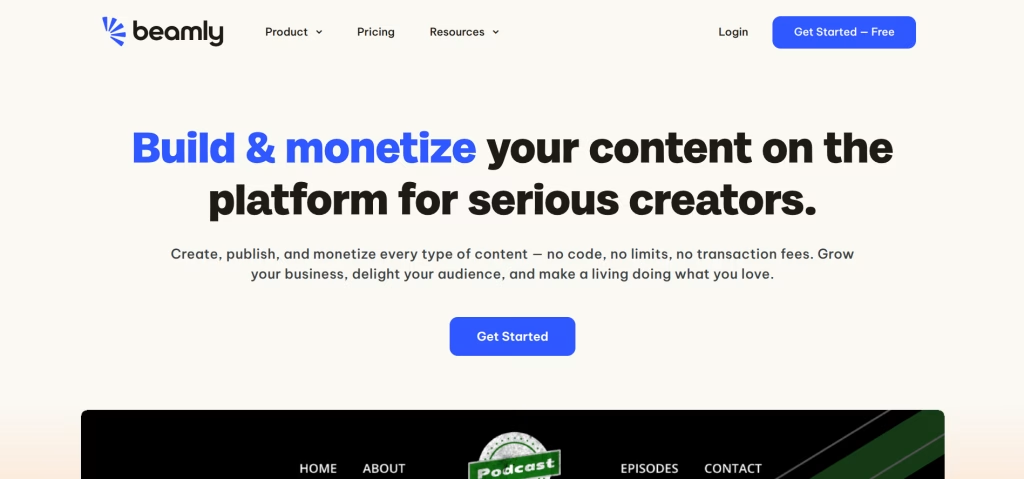
Publishing in multiple places is fine. Building a business on platforms you do not control is risky. A solid baseline for long-term creators is to keep platforms as distribution, but build an owned hub where the content library, email capture, and monetization live.
Beamly is an all-in-one, creator platform to build, publish, and monetize podcasts, videos, blogs, courses, and downloads – alongside a full website on your custom domain.
Here is what matters for creators in practical terms:
- Publish on an owned hub: build your platform under your brand with the Website builder and Publishing.
- Unify formats: publish podcasts, videos, and SEO blog posts on one domain so the library supports itself.
- Import and sync existing content: import podcasts via RSS with Podcast hosting and sync YouTube into an owned library with Video hosting.
- Monetize under your own brand: sell premium access with the Membership website platform and flexible paywalls.
- Sell digital products: offer templates, guides, and downloads using Digital downloads and the Online store.
- Keep fees predictable: Beamly charges 0% platform fees (Stripe processing fees apply). See Pricing.
- Use built-in AI: generate transcripts, summaries, and SEO metadata to speed up publishing.
If you want to publish in one place and build a stable creator business layer under your own brand, Beamly is designed for that.
FAQ: types of content creators
What are the main types of content creators?
The most common types include video creators (YouTube), short-form creators (TikTok, Reels, Shorts), podcast creators, writers (or publishers), newsletter creators, educators (courses/workshops), and UGC creators who produce content for brands. Social media influencers and visual creators (photographers, designers) are also significant types that often blend with other categories.
How many types of content creators are there?
There is no official number. The useful approach is to categorize by format (how content is made) and by business model (how content turns into income). Most creators are a blend, but one primary lane usually drives results.
What are different types of content creation?
Types of content creation commonly include long-form video, short-form video, podcasts, livestreams, blog posts, newsletters, social posts, visual content (photography and design), community content, and educational products like courses and workshops.
What type of content should I create?
Start with what you can sustain. Choose one format that fits your strengths, then pick three repeatable content buckets (teach, show, prove). Commit to one primary lane for 8-12 weeks, then evaluate based on retention, saves, replies, and conversions.
Are types of content creators on YouTube different from other platforms?
Often, yes. YouTube creators are usually building a searchable library, so long-form tutorials, reviews, and evergreen series tend to perform well over time. On short-form social platforms, frequency and hooks matter more because content is more feed-driven. The workflows, skills, and growth timelines are different enough that it is worth treating them as separate lanes, even though the tools overlap.
Do content creators need a website?
It’s smart to publish (and possibly monetize) under a platform you own. You can always cross-publish on other places, but build your own platform as the main one. This becomes a significant advantage as the library and audience grow. It enables SEO, email capture, engagement, better monetization (memberships, products, courses), and reduces dependence on platform algorithms. For creators serious about long-term growth, building a hub early pays off.
Conclusion
Understanding types of content creators makes it easier to build a real strategy instead of publishing randomly and hoping something sticks. When the format and the business model are both clear, publishing becomes repeatable and growth becomes something that can actually be measured.
Pick one primary lane, stay consistent long enough to learn what works, and build an owned hub early so the effort compounds instead of resetting every time a platform changes.
If you want a hub that supports multiple creator types – podcast, video, blog, courses, memberships, and digital products – on an owned website, Beamly is built for that. Learn more at Beamly or start with the Publishing and Website builder features.
Ready to build an owned hub instead of renting attention? Try Beamly free.