
Regardless of which blogging platform or tool you’re using, the best blog SEO is a system. It starts with posting the right topics so content is actually searched for, and matching search intent so the page earns clicks. From there, the post must be structured for scanning, supported by a library of internal links to build authority, and hosted on a site with no technical barriers so it can be crawled and indexed instantly.
This guide is written for creators and small teams who want blog traffic that compounds. It covers blog SEO strategy, on-page best practices, a blog post SEO checklist, and the tools that make execution easier. We’ll learn how AI is re-shaping the blogging space, how to leverage AI for improving your SEO, and how to rank for GEO/AEO – the equivalent of SEO within modern AI tools.
What blog SEO actually means
Blog SEO is the process of making your blog posts discoverable in search engines and competitive for the queries they target.
It includes topic selection and keyword research to decide what to write, followed by careful content structure and on-page optimization (titles, headings, schema). Beyond the page itself, it requires technical basics like indexing and site speed, along with a strategy for library building through clusters and updates.
The fastest way to improve blog SEO is often counter-intuitive: more posts won’t necessarily equal more traffic – focus on publishing fewer, better posts that earn trust and accumulate internal and external links over time.

Successful blog SEO starts before writing
The most common blog SEO issue is writing good posts about topics nobody searches for. Work your way through existing market “pulls” around trends or current topics that are search-worthy and interest people. Riding an existing wave is easier than trying to rank for a keyword that’s been around forever.
Step 1: Start with a simple list of keywords
For most creators, a lightweight keyword list beats that focuses around the topic you want to write on is key. Once you have your main topic/idea in mind, research SEO platforms like Ahrefs or SEMrush, understand the real, underlying search intent and what actual value you can contribute.
Then come up with a list of 5-10 most relevant keywords on the topic you’re on to.
Step 2: Keep posts focused on their primary topic
Each post should have one primary job: teach a specific process, answer a specific question, compare specific options or help someone choose the next step.
Don’t try to do everything on one page. Also keep the topics focused on each page to avoid keyword cannibalization across posts.
Step 3: Support popular posts with a cluster
When one of your posts hits a decent amount of traffic, or targets a very popular keyword, clustering can help you reach the next level. Creating clusters can signal search engines and AI tools you have real understanding and authority on a certain topic. It can also help send more “juice” to the main article if you have a pillar content piece.
A smart approach is to write the best “hub” page for the parent topic, then add supporting posts that answer narrower questions. Over time, the internal links between them make the whole library stronger.
How to write SEO-friendly blog posts
When you think about writing SEO-friendly blog posts, always keep in mind that your outputs should deserve to be among the top best answers for a certain search query. Repeating what you read on other blogs, or posting a dull article that does’t bring anything new to the table is not going to go anywhere.
The basics may sound simple, but perfecting those would most likely earn you some traffic.
1) Write a title that converts
Besides being relevant enough to your topic and include your top keyword, a good blog SEO title needs to encourage people to click. If you only get a 0.5% click-through rate when people see your page on Google, you’d have a hard time to convert this into real traffic.
2) Use a clear and relevant headings
Use H1-H6 headings to target relevant topics and keywords. This is also very useful for scanning through a post rather quickly without reading the whole page. A table of content can also help readers navigate between sections.
3) Mention the best parts at the top, then expand
Readers want confirmation quickly. A strong intro or quotable section can help getting more eyeballs on your post. Try to include the top takeaways, gists or findings at the top to prove there’s actual value in the article.
After that, expand with more info, examples and more.
4) Add internal and external links
Internal linking help both users and search engines.
When you properly add internal links within your blog, it transfers “juice” to the relevant pages based on the linking keyword/term. This helps improving discoveability and indexing your site and ranking some of the pages.
External links, on the other hand, add credibility and give you more flexibility to recommend other in-depth resources.
How AI is reshaping blogging: from rankings to answer visibility
AI-first experiences now summarize answers directly in tools like Google AI Overviews, ChatGPT, Perplexity, and Copilot. That changes the game for creators and publishers: posts still need to rank, but they also need to be easy to quote, extract, and trust. Clickthrough rates are down quite a bit and become less and less obvious with time.
In practice, that means blog content should focus on these three things:
- Rank for a target query in traditional search
- Answer specific questions clearly enough for AI systems to cite
- Build enough authority that your site is treated as a reliable source over time
How to use AI to improve SEO without lowering quality
AI works best as a production multiplier. If you expect an AI engine to simply write full blog posts for you and still rank with those – you might have to re-think your strategy.
AI engines usually tend to balance towards the generic or “average” answers across everything. Average article length, average talking points, average content and so on. It won’t usually bring a fresh angle on topics or produce a piece that’s really worth reading more than other posts.
When you bring your own personality, viewpoint and first-hand examples, real recommendations, and clear structure – you get an edge over the enormous amount of slop.
AI is still great to iterate, research, write outlines or reword a few sections – not using AI would be a mistake just like overusing would be.
GEO and AEO: the AI-era equivalent of SEO
GEO (Generative Engine Optimization) and AEO (Answer Engine Optimization) focus on being selected in AI-generated answers. It’s hard to define exactly what makes a post worthy of being quoted by AI tools, but here are a few possibilities for you to focus on:
- Answer core questions early with 1-3 sentence summaries
- Use clean heading structure and FAQ (with schema) sections for extractable answers
- Include concrete examples, data points, and source links where relevant
- Keep entity clarity high (brand names, tools, concepts, and definitions)
- Update important posts when facts, tools, or workflows change
Programmatic workflows
One great example for leveraging AI is connecting your AI assistant to data-sources. You can use Ahrefs MCP or Semrush MCP to let your AI assistant plan an outline based on the real-world keyword data.
You can ask for keyword suggestions, potential cluster opportunities, content gap, writing SEO metadata and more.
This turns your entire SEO process to a more detailed and tighter workflow that can scale without hiring a team or investing all your time into it.
Common blog SEO mistakes that can kill traffic
Many blog SEO failures happen because of similar issues. Here are a few you should try to avoid –
- Publishing without a plan: random topics do not build authority.
- Targeting keywords that are too broad: when your post competes with massive sites it’d probably never break through.
- Ignoring internal links: posts become isolated pages that never gain strength from the library.
- Focusing too much on technicalities rather than actual human readers: The bottom line is that you should produce genuinely helpful content that humans would enjoy reading. Putting too much emphasis on optimization, keywords and so on may miss that mark.
- Never updating good posts: remember to update all your posts once in a while – search engines tend to promote recency.
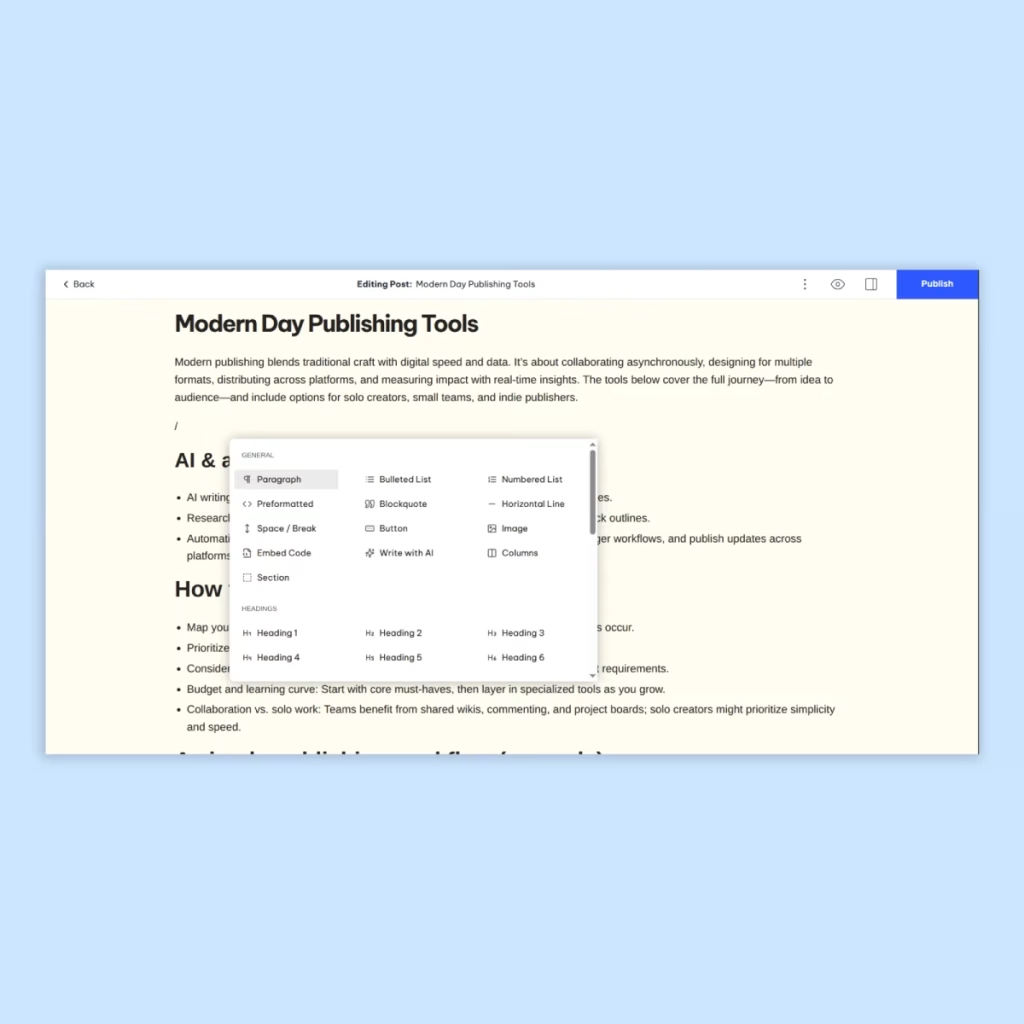
Where Beamly fits: publish a blog that grows on an owned website
Blog SEO works best when the blog lives on a website you control, where content can connect to email capture, memberships, and products.
Beamly is an all-in-one, no-code platform to build, publish, and monetize content across formats (blogs, podcasts, videos, courses, and downloads) alongside a full website.
Here is how Beamly supports the best blog SEO system:
- Publish on an owned website: build a content hub on a custom domain with a modern editor and flexible pages (Website builder and Publishing).
- Built-in SEO foundations: structured data, sitemaps, and SEO controls so content can be indexed and shared cleanly.
- AI assistance for speed: use built-in AI to accelerate drafting and generate SEO metadata drafts so publishing stays consistent.
- Turn traffic into revenue: connect blog posts to memberships and premium content (Membership website platform), and sell digital products and downloads directly on the same site (Online store and Digital downloads).
- Build topical authority across formats: publish blogs alongside podcasts and videos in one hub, so the site becomes a real library instead of a single channel.
For creators who want to publish consistently and turn blog traffic into owned subscribers, members, and customers, Beamly gives an end-to-end setup. Try Beamly free.
FAQ
What is the best blog SEO strategy?
The best blog SEO strategy is to build a library with your best posts. Choose topics with real search demand, match intent, publish the best answer, connect posts with internal links, and keep technical SEO clean so pages can be crawled and indexed. It’s also super important to keep posts updated over time – don’t let them go stale and lose traffic because of that.
What is GEO/AEO and how is it different from SEO?
SEO focuses on ranking pages in search results. GEO/AEO focuses on having your content cited or summarized in AI-generated answers. In practice, strong sites need both: classic ranking visibility and AI-answer visibility.
How can AI tools help improve blog SEO?
MCP, tool calling or other integrations within AI tools can let AI assistants pull actual live keyword and topic data, cluster it by intent, and generate prioritized content briefs or update queues automatically. That saves research time and keeps planning grounded in real demand instead of guesswork.
What is a good SEO checklist for blog posts?
A good SEO checklist for blog posts covers intent, on-page structure, metadata, internal linking, and technical basics. The checklist section above is designed to be used right before publishing.
How do you write SEO-friendly blog posts without keyword stuffing?
Start with one primary keyword and write a post that answers the query better than alternatives: clear headings, direct answers, examples, and internal links. Use related phrases only where they fit naturally, and keep the writing human.
Conclusion
The best blog SEO is to keep publishing high-quality content consistently. Make sure there’s enough demand for content you’re targeting. There’s no hack nor tricks that’d guarantee you good rankings, especially in the age of AI. Techniques that worked months or years ago can’t be used reliably and the real answer has always been high-quality, genuinely helpful content so make that your top priority.
For creators who want an owned content hub where blog posts can compound and connect directly to monetization, Beamly can help with a no-code website, publishing tools, built-in AI, and memberships and digital product sales in the same place. Try Beamly free.